Ramin Noorollahi
Ramin Nourollahi

Proposal title: Continuous-time modeling of integrated energy systems
Ph.D. period: 2019 -2022 (Estimated)
Supervising Team: Prof. Kazem Zare, Prof. Behnam Mohammadi-Ivatloo, Dr. Vahid Vahidinasab, Dr. Amjad Anvari-Moghaddam
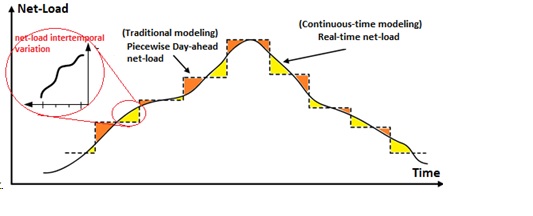
By increasing the penetration of renewable energies in power systems, the system operators have faced new challenges, including required variable sources, higher levels of uncertainty, and ramp requirements of net-load (electrical load mines renewable power). The current economic dispatch modeling methods use the piecewise zero-order functions for modeling the parameters and decision space of economic dispatch optimization problems of the power system. This modeling is not appropriate in accurately modeling of real net-load as well as ramping of generation units, storage, and flexible loads. Additionally, the modeling of continuous-time is a new approach for energy systems’ economic dispatch problems as a variable-control/optimal continuous-time optimization problem. This approach models the ramping trajectories as time derivatives of generation trajectories leading to the real quantity of ramp and flexibility requirements. The continuous-time modeling of pricing and scheduling problems leads to the definition of continuous-time marginal prices which accurately considers the effects of ramp constraints and intertemporal effects of storage and flexible loads as well as the effects of continuous-time power flow constraints on decision space. By and large, a decision-space solution proposes the following statements:
- Reducing the dimensions of continuous-time unit-commitment problems.
- Fixing the weaknesses of the discrete-time modeling.
- Prevention of damages to the unit-commitment flexibility in the generation units, storage devices, and flexible loads.